
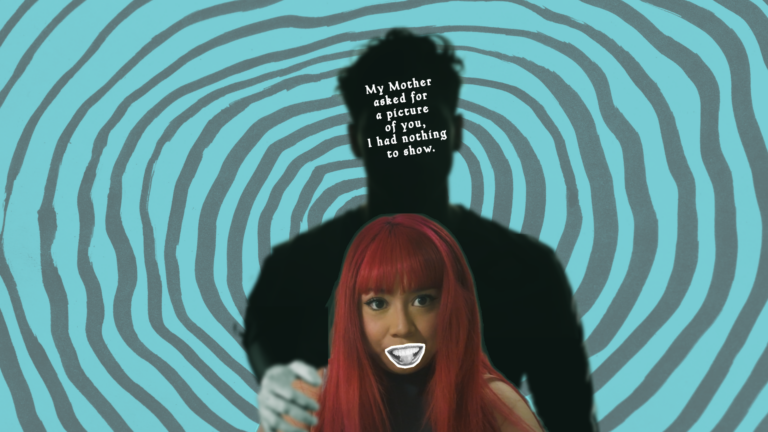
By Dalia Guzman-Perez
1,019 messages were discarded when I pressed delete. 1,019 messages were what iMessage was referring to when it prompted “This conversation will be deleted from all your devices.” 1,019 messages were sent back and forth over a period of four months. A relationship’s strength can’t and shouldn’t be measured by characters on a little screen, but when you question if what you cared for was even real, you gather up every little artifact, hoping those little slivers of paper don’t get lost on the way to your confetti jar. The delete button is easy. It’s the aftermath that’s harder, when I wonder if erasing the evidence erases the experience itself. Not that there was much evidence of a relationship to begin with; in a courtroom there would be reasonable doubt.
“I will do you the dignity of forgetting we were ever anything more than coworkers.” That was the last message you sent me. The formality of it struck me even then; “dignity,” as if forgetting were an honor you were bestowing on me. As if memory were something either of us had control over. As if forgetting would undo what we once were.
Forgetting. Are you really capable of forgetting? I can’t fathom the idea of locking away a memory, of willing something that happened into something that didn’t. But that’s one of the many differences between us; you forget while I archive. Juxtapositions were always central in our relationship. The archiving began earlier than I realized. I still remember the day you asked me to keep our relationship a secret, to surprise everyone by someday revealing what we’d been hiding. I thought the idea was fun; I had always been a big fan of surprises. I didn’t see it then for what it actually was: the first design specification.
A relationship with no witnesses.
A relationship with no transcript.
This was a relationship designed to be forgettable, built with planned obsolescence from the start. Unfortunately, I never was one to read the terms and conditions before clicking accept. In relationships, a bond builds up a shared language; shorthands for “I need space,” established reconciliation rituals, accumulation of tenderness that softens hard conversation. It is difficult to foster that language in a relationship that won’t commit to its own existence. We never really had that infrastructure. Sometime ago, in my Intro to International Affairs class, I learned about Samuel Huntington, a political scientist who emphasized that strong institutions must precede mass political participation; If we were a state, I could see us being a case study.
The problem, of course, is that case studies require documentation. But how can I get documentation if this relationship was engineered to leave none? Most of what happened between us happened in your dorm room, in stolen hours that evaporated the moment I walked back out into the hallway.Or at night, tucked away in a bench shrouded by bushes, with the world shut out; or was it us shut out from the world? No photos.
No friends to verify the timeline.
No meals made.
No voicemails saved.
No us.
No ours.
Just two people and whatever we said to each other when no one else was listening. The 1,019 messages I deleted weren’t love letters. They weren’t explorations of each other, or even expressions of feeling. They were logistics. “Are you free tonight?” “Coming.” “Where are you?” The actual relationship happened in the gaps between those texts; the hours coordinated but never documented. What the messages reveal isn’t what we felt, but how we operated: the infrastructure of stolen time. I fear it was about time we were caught stealing. There it is. “I fear.” A phrase I’ve heard from you so often, it has wormed itself into my vocabulary. I wonder if there are words of mine you use. Language doesn’t delete as cleanly as text messages. But to use language you have to understand it. Did you ever understand me?
The question itself reveals the problem. After all those stolen hours, I still don’t know the answer. Maybe that’s what happens when you build intensity without infrastructure: you mistake proximity for intimacy and frequency for depth. Our conversations circled commitment endlessly. What are we? Do you care? Will you value me? The same questions, different configurations, hoping each time for a different answer. That’s not where intelligence lives. That’s where vulnerability, repetitiveness, grasping at something being withheld resides. You never saw me write. You never heard me think. You never encountered the parts of me I actually value. You saw me wanting, and I kept showing up to want in slightly different ways, as if the problem was how I asked rather than what you were willing to give. The writer, the thinker, the person with something to say; she stayed outside your dorm room. She never had witnesses either.
I knew monkeys were a recurring thing for you.
I assumed you’d remember my birthday.
I knew your plan to join the peace corps and become a logistics officer.
I assumed you’d know my favorite color is pink.
I knew who you wanted your ‘left hand man’ to be.
I assumed you knew I was a writer.
I knew I cared for you.
I assumed you cared for me.
The gap between knowing and assuming is where we lived. In that space, I constructed a version of you from fragments; your “I fear’s,” your peace corps plans, your monkeys. You must have done the same with me, building someone from whatever scraps I left behind in your dorm room. We were in a relationship with our own projections. It is because of that, when the real people showed up, we didn’t know what to do with them.
I still remember the shock I felt the night before winter break. We were working together that day. Laughing between tasks, singing Christmas songs together, stealing kisses when no one was looking. We then had Chipotle for lunch, and the conversation turned to time; how little we’d had lately, how the stolen hours were getting harder to steal. I don’t remember what shifted the conversation; maybe I asked when we’d see each other after break, or maybe I said I missed you. Whatever it was, it turned. The stolen hours, the lack of time; the whole architecture of secrecy suddenly felt unsustainable when I said it out loud. You said something back. I don’t remember what exactly, but I remember the tone. I left; you stayed. That was the only time our roles were reversed. Your apology appeared while I was gone. The first apology you’d ever sent over text. The first time an emotion was kept as a record.
All our difficult conversations had lived in spoken words, designed to evaporate. But I didn’t see the message until work resumed, and by then I was replaced. The archive shows I was there; it doesn’t show I was dispensable. That night, we texted. The conversation that any other day would have happened in your dorm room, where words could dissolve, was crystallized on a screen. I asked if you cared about me, even as a friend.
“What I don’t care for is work, and you tend to be a lot of work.” This is one of the few exchanges I can reconstruct verbatim. Not because I saved the texts, but because pain has a way of committing itself to memory even when everything else evaporates. I asked to see you once more. Our hard conversations had always happened in person, words disappearing into the air. I wanted that escape route; the dissolution that comes with the unrecorded.
“Rain check. Use it wisely and maybe we’ll be friends again.” I never did get that rain check. But I got the text. And unlike everything else we said to each other, that one stayed.
Two weeks after winter break, the chat box that had been collecting cobwebs came back to life. Not a single message was positive. It had never stayed like this before. Our arguments had always dissolved back into normalcy. But this time the record shows only escalation. You blamed me for the negative emotions inside you. It wasn’t the first time, far from it, but it was the first time I didn’t apologize, didn’t accept it, didn’t believe it. My New Year’s resolution had been to make people happy. I’d told you that before break. You said New Year’s resolutions were useless. For a moment, I’d believed you. Making people happy requires kindness. No matter how many times you’d attacked my character, catalogued my flaws, and listed every negative detail, I’d never pointed out yours. It had always been “I feel” and never “you are.” The infrastructure we lacked included a vocabulary for fair fighting. I’d tried to build one alone.
But this time, my words were about you. I said things I’d never said before, never planned to say. Things I knew would hurt because I’d been watching you closely enough to know where the soft spots were. “For someone who wants to save the world…I don’t know if that’s what the world needs.” The archive preserves this. I can’t claim it evaporated with all the other words. It’s there, crystallized, along with “you tend to be a lot of work” and “use it wisely.” The worst of us got documented, while everything gentle evaporated.
You forget while I archive. That was one of our differences I claimed. But building an archive and writing about it are not the same thing. Archives are private, a collection of fragments and patterns I notice. This essay is…what even is it? Public testimony of something that was designed to leave no witnesses. Maybe that’s what I needed. To take what evaporated and commit it to permanent form. To document the undocumented relationship, to create the transcript that never existed. But I’m not sure what I hoped to accomplish. You said you’d do me the dignity of forgetting. I refused. Instead I built. A record of absence. A catalog of what wasn’t there. The archive was supposed to prove it was real. Does writing about it accomplish that, or does it just create another kind of record? A relationship requires two people to tell its story. Your version isn’t here. I never knew what it was. I still don’t know. Maybe that’s the point. You forget. I archive. And neither of us gets to control what stays.

Unbelievably good writing
DALIA!!!!! You’re such an amazing writer, truly such a heartfelt and vulnerable essay. “You forget while I archive”, what a powerful statement.
poetry
A really good blog and me back again.
I keep finding myself coming back