Gorillaz wasn’t supposed to be a normal band; that was the whole point. Damon Albarn and Jamie Hewlett were both fed up; Albarn with the music industry’s obsession with celebrity ego, Hewlett with the creatively bankrupt landscape of late-90s pop culture. So they did the most logical thing: they invented four cartoon characters to be the face of the whole operation.
No Real faces. No red carpets. No pap shots outside The Ivy. This was a direct middle finger to what Albarn called the “celebrity virus,” the industry’s nauseating transformation from being about music into being about manufactured personalities, award seasons, and the relentless, exhausting spectacle of famous people selling themselves. The ego was the product, and Gorillaz wanted to kill it.
And it worked! The music was political, weird, collaborative, and unlike anything else. The most popular example of this was “Feel Good Inc.” It wasn’t just a banger; it was a critique of the herd mentality and hollow pleasure-loop of consumer culture. Fuck, they even wrote Plastic Beach, a whole album dedicated to how capitalism is killing the planet. These weren’t B-sides; this was the main event.
The political nature of Gorillaz is what got a majority of fans through the door. They weren’t just buying music; they were buying into an idea. For a long time, that idea held.
The Now Now, however, was the first crack. It was a beautiful album. It’s personal, introspective, the kind of thing you listen to and look back on your life with fondness, but it was quieter politically, which is fine! Artists need to breathe, personal work matters, and no one is required to be a protest singer forever. However, their behavior soon became hard to defend.
They started releasing singles before albums. I get the strategy; in the streaming era, you need to keep the algorithm fed. But Gorillaz? The band that built their entire identity around rejecting the manufactured mechanics of pop? These guys??? Releasing pre-album singles to maximize engagement is exactly what every other number-driven machine does.
Then came TikTok. In 2021, they made a TikTok account where they made animated shorts of their characters. Already a little weird, but the animations? The beautiful, strange, handcrafted aesthetic that made Gorillaz was gone. Replaced with that smooth, soulless 3D style that looks like every modern Disney direct-to-streaming side project.
More shit piled on when they dropped a series of NFTs. They cancelled them after fan backlash, which is good, but the fact that it happened at all makes you question the entire band’s ethics.
And then—and I want you to really sit with this—they did a Fortnite festival. The band that was created specifically to reject celebrity and the commodification of identity, is now a skin you can buy in a video game. Just…what the fuck?
Fans started to notice this, and shit, I didn’t listen to the entirety of Cracker Island because of it.
But here’s the thing about genuinely good artists: sometimes they come back to themselves. And I think—I hope—that’s what The Mountain is.
The album came out of something real. Albarn and Hewlett both went on a ten-day trip to India together, and while they were there, both of their fathers died. Their grief became a shared language of what followed, and The Mountain is the result: a meditation on mortality, designed to build a sonic bridge between the living and the dead.
It’s a good album, but the thing I’m obsessed with is the short film.
The Mountain, the Moon Cave, and the Sad God is 18 months of hand-drawn animation. In the year of our lord 2026, when every major entertainment corporation is replacing artists with AI slop and calling it innovation, Gorillaz releases a hand-drawn short film. They intentionally left imperfections, shown by the photocopy degradation and the visible pencil lines, leaving in their wake the evidence of human hands.
That is a political statement. That is the original Gorillaz.
The film opens on Noodle alone in the jungle, half-dressed in a Jungle Book situation, stripped of the band’s usual visuals. There’s no costume, no persona, no pop star packaging. Just a person in a forest. Obviously, though, she still needs to be fully covered, so she steals some clothes from a guy bathing in the river and goes to find the rest of the gang.
From there, the mountain is a metaphor for life: overgrown, chaotic at the base, and full of a thousand diverging paths. As the band ascends, the terrain narrows, the paths collapse into one. This isn’t presented as a loss; it’s presented as truth. Life gets more specific as it goes on; the options don’t multiply, they reduce. It’s not a tragedy, it’s just the shape of the thing.
The film is structured around two songs from the album, “The Moon Cave” and “The Sad God.” During the climb towards the first, 2-D stops to buy snake oil from a guru sitting on the mountain, only to pull out a fly to pay for it. We live in a moment where Target sells evil eyes, and Amazon will deliver you a manifestation journal in two business days. Spirituality has been fully absorbed into the marketplace. It’s been repackaged, optimized, and sold back to us at a markup, stripped of anything that might actually require effort or discomfort. The shortcut is always available for purchase. Enlightenment is always one more product away. 2-D reaches for it the way we all reach for it, which of course, leads to nothing, because it does nothing. The film reminds us that we cannot cheat life, and the climb will continue whether you bought crystals or not.
As the band continues to climb, they enter the Moon Cave. The film transitions from the physical greenery of the jungle into something ethereal. The walls are lined with a living history of their past. Animated paintings of their past collaborators who are now gone: Bobby Womack, Dave Jolicouer, Trugoy the Dove of De La Soul, and many more. Their haunting vocals set the tone as the figures jump to life and perform one last time.
The Moon Cave is a representation of where our art began, taking inspiration from the cave paintings that were once crafted with nothing but human hands. We are a culture built on other people and not machines or algorithms. Every innovation, every sound, every way of seeing the world that has ever mattered was handed to us by someone else. You are, in no small part, a product of every person who came before you.
It’s a moment of pause before the final ascent, a breath.
Then the cave opens onto a lake. This is the place where it ends, and it absolutely wrecked me.
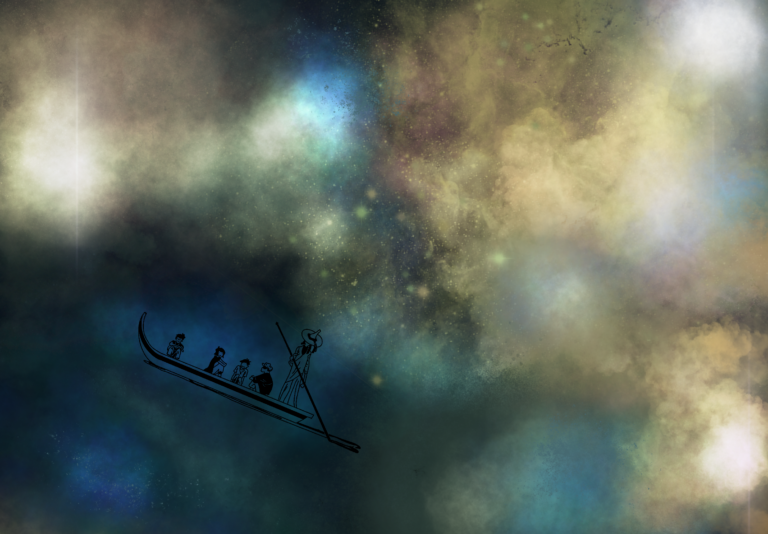
The band is met at the edge of the cave by a mysterious boatman who ferries them to the center of a glass-still lake. Black Thought is rapping, and Anoushka Shankar’s sitar is cutting through the silence like it has a personal grievance with the quiet.
The Sad God is never named outright, never explained, but you know exactly who it is: the witness. The melancholy presence of a creator, watching the physical self reach the point it can go no further. It’s not angry or punishing, it’s just sad watching things end—even when the ending is right. The film suggests that we spend our lives chasing material things like war, wealth, or status, when the real journey is always internal. More about stripping away rather than accumulating.
Noodle turns to 2-D and Russel, mouths “I love you,” before jumping. They follow her without hesitation into the dark water. (Murdoc, to his credit, eventually follows).
The film cuts to a sunrise over Earth. Energy is released back into the universe, and the cycle begins again. Reincarnation is not a mysticism but a simple, undeniable fact; nothing disappears, it just becomes something else.
The film’s thesis is a gut punch. It highlights how consumer culture doesn’t liberate you with more choices, but instead traps you at the base of the mountain. Everything is loud and lush, and there are infinite paths that lead nowhere. The climb towards meaning, towards truth, towards the end of a life well-lived, requires reduction. You shed the excess, you narrow, and you choose to put things down that you thought defined you, and you keep climbing anyway.
Gorillaz built their entire existence on this sole idea. It’s in the cartoon avatars killing the ego. It’s in Plastic Beach. It’s in Feel Good Inc. It’s been the argument from the very beginning. Somewhere between the TikTok animated shorts and the Fortnite festival, they forgot it…or were distracted by it…or got eaten by the exact machine they spent twenty years critiquing, which, honestly, maybe adds to it in a meta way.
What matters, though, is that they spent eighteen months drawing this film by hand. They left evidence of human life in an era where corporations use AI to produce high-volume, mind-numbing content at an industrial pace. In a time when efficiency means success, Gorillaz made something inefficient on purpose, arguing that anything fast enough to be mass-produced probably isn’t worth your time.
I’m glad they made it. I genuinely missed them.