Phoebe Bridgers can take my phone anytime, by Sofia Calabrese.
Phoebe Bridgers was never meant to get big. The tender, Elliot Smith-inspired approach to her music always felt like it was destined to be performed in the basement of some local bar. Bridgers’ songwriting feels like it had already been penned in the era of Smith, and paradoxically, could only have been written in the current moment. That is precisely why she has, time and time again, exceeded the expectations of how someone of her artistry can succeed.
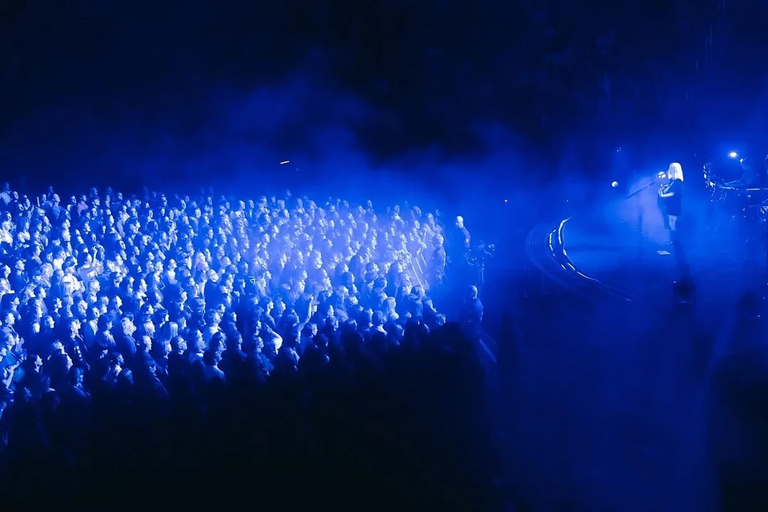
Making the second stop of her career in Washington, D.C., Bridgers performed to a crowd of 19,000 in Capital One Arena on September 29, 2026, for her sold-out Lost Tour to promote her third studio album, Lost Weekend. This venue was a big shift from her previous residency at D.C.’s The Anthem – the small concert venue holds 6,000. Despite this change, it was no less intimate.
This closeness was felt due to the most widely discussed aspect of this show: the no-phones policy. Going into this concert, I had no qualms about this rule. I always had a hard time letting myself enjoy a performance without feeling the need to document it. This rule would force me to be in the moment. Still, several other fans of Bridgers cited poor memory and anxiety regarding safety and accessibility as reasons they were opposed to the ban.
I found that the modified experience was relatively easy to navigate. The process of buying concessions and merch was quick, even with the intense-looking lines (which were typical for a venue of that size). However, the greatest struggle I encountered was accessing the time; once my phone was locked up in the Yondr pouch, I was forced to only guess. The wait between opener Alex G and Bridgers’ set felt eternal. It could have been that my lack of a sense of time was causing this uncomfortable feeling, but more likely I was deprived of the constant stimulation that I – and virtually everyone – have grown dependent on. It’s a reflection of why Bridgers decided on this unconventional enforcement.
When the show started and I looked into the crowd, I noticed that not one phone was in sight. I felt emotional when it occurred to me that everyone in that room – all 19,000 of them – was just as present as I was, making the concert equally as charming as any smaller venue.
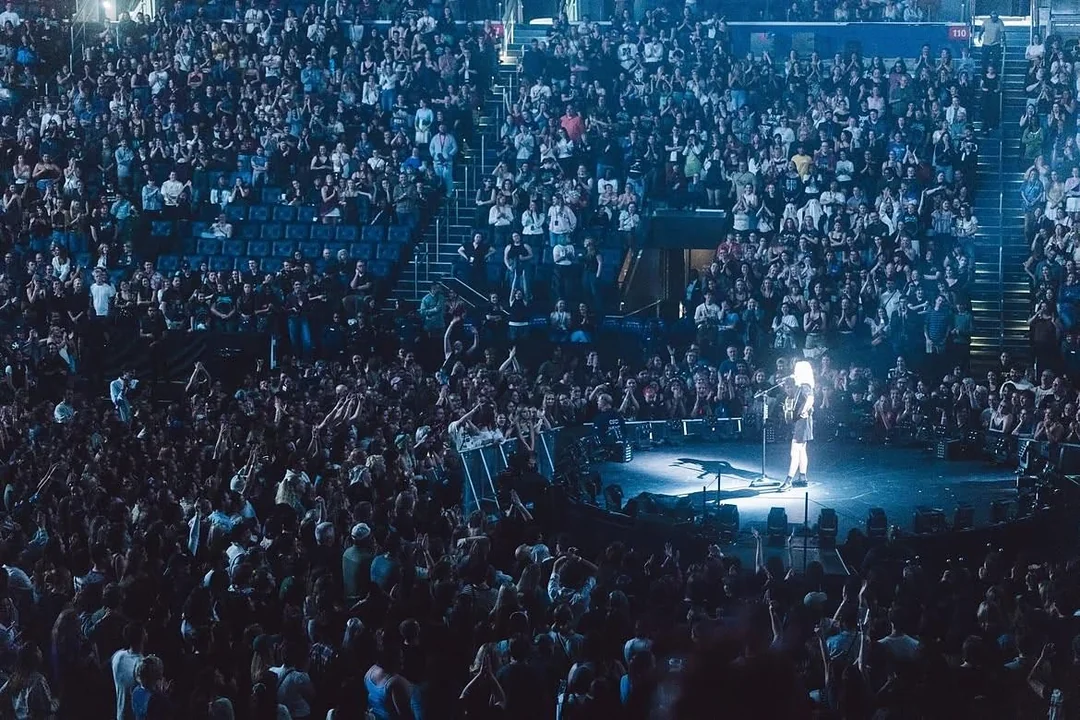
The stage design could not have been more conceptually or practically dissimilar. There were two separate stages; one was a traditional proscenium-style that sat at one end of the floor and the other was a smaller, 360-degree stage that was placed at the other end.
The traditional main stage had a huge shell that would open and close when Phoebe went back and forth between stages. The shell had its own set of lights and a screen that would project abstract animations. It was surreal and reminiscent of UFO imagery, which Bridgers’ used while promoting Lost Weekend (the stops during her surprise tour prior to the official release of the album were all in cities that had heavy ties to alien history).
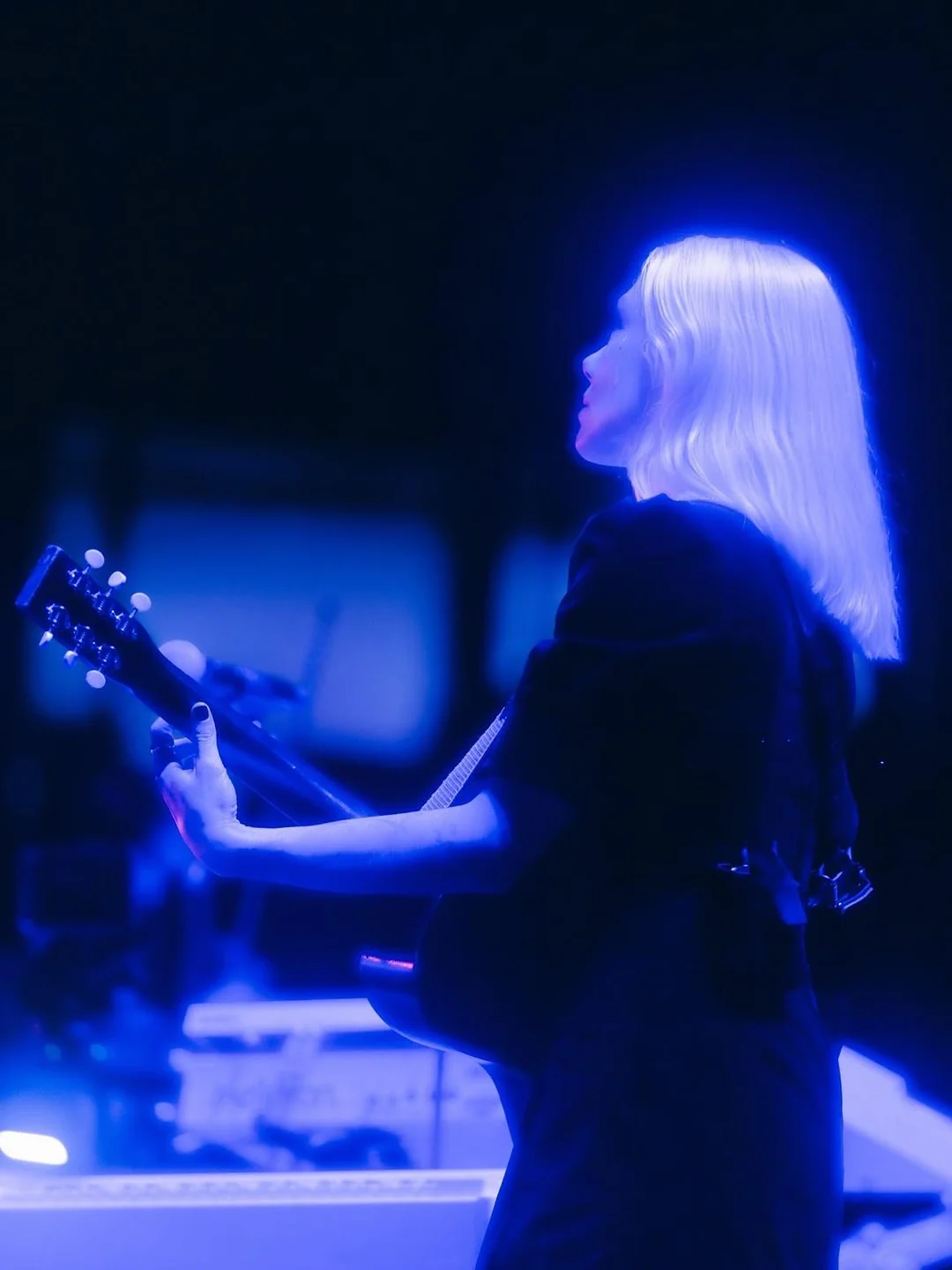
The circular stage, on the other hand, used limited set pieces, which made for a more intimate feel. Most of her acoustic-led songs were performed here, as she had her acoustic guitar, a synthesizer, and a quartet of strings with her. There was one large set piece that hung above this stage: a huge disco ball.
The most memorable use of lighting was during her performance of “Lost Weekend” on the second stage with this giant disco ball. The lighting exploded with color and movement during the chaotic instrumental ending of the song. It was as if the lighting technicians slammed their hands on the board, letting any type, color, and intensity of light bleed through. With the purposeful lighting design, no phones made moments like that especially pop.
Alex G and his supporting band performed at this stage too, but his sound was much less quiet and reserved than Bridgers’; he had a full band with an assortment of guitars that heavily emphasized the rock elements of his music. The set ran for about an hour and the group sounded amazing every minute, even though the crowd was not very engaged as he played a majority of his lesser-known and experimental material from his 2025 release, Headlights. Some fans also disliked the lighting used for his set, saying that it was too abrasive, though I did not find that to be the case at my show. I found both Alex G’s and Bridgers’ lighting to be bold but necessary for the immersive experience they were aiming for.
The apex of immersivity at the concert was the various moments of catharsis I experienced. Bridgers is known for her catchy, gut-wrenching song lyrics, so it is a privilege to be able to scream them in a room full of other fans who know just how powerful they are. During the performance of “I Know the End,” right before the height of the song where Bridgers yells at the top of her lungs, she grinned and addressed the audience, asking, “You guys ready?” A room full of strangers became a room full of like-minded individuals releasing and then healing whatever heartache they were carrying with them. That is the power of Phoebe Bridgers.
The other moment that brought the crowd together was the reveal of her chosen ‘surprise song’ for this show. The term ‘surprise song’ originated from Taylor Swift’s historic Eras Tour, where Bridgers was actually one of the openers (this was the first time I saw her perform live!). Every new show, Swift would choose two songs from her discography to perform, making each show unique. For Bridgers’ D.C. show, she chose “Chinese Satellite,” off of Punisher, a beloved fan favorite.
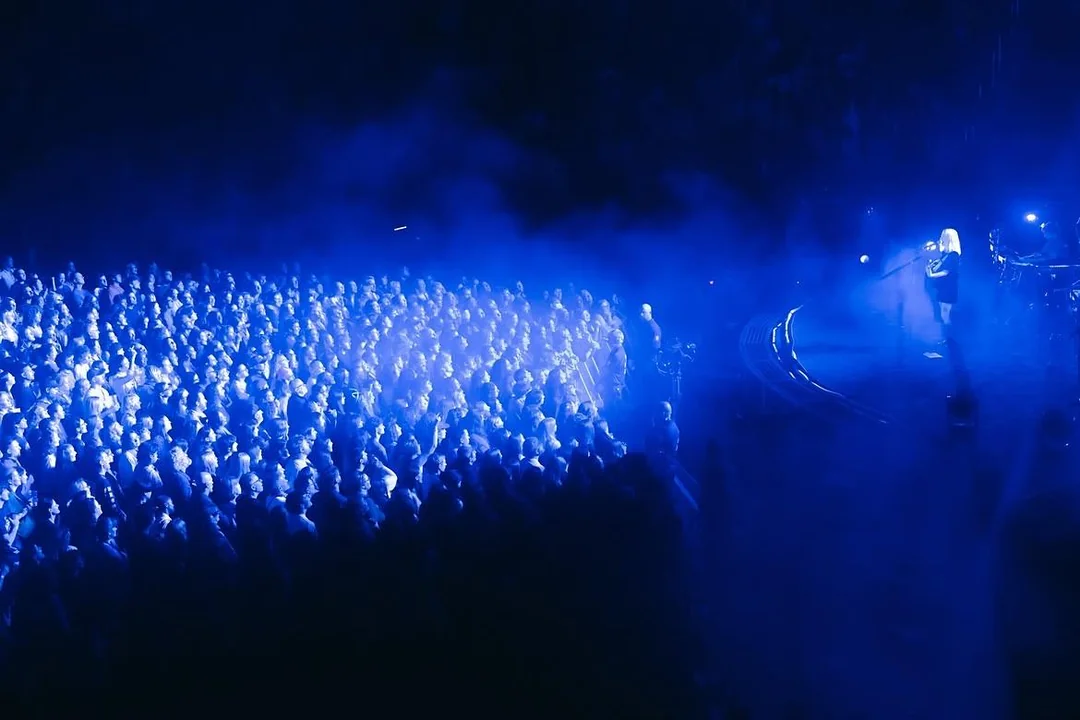
Bridgers did not just perform for the full one hour and 40 minutes, she also spoke with the audience. She commented on her turbulent relationship with her late father and how it inspired Lost Weekend. She even interacted with the crowd, asking, “Who here has a complicated relationship with their parents?”, to which she was met with a wave of hoots and hollers. Bridgers also talked about her disdain for Trump and even likened him to her abusive father. She also had other things to say about the president, but when it got a bit heated, she jested, “Whatever, you guys don’t have your phones anyways.”
This last sentiment was what defined the entire concert for me. It was clear to me that Bridgers made this phone policy because it would help her be vulnerable with so many people without the threat of her every word being taken away from her authority. Her small quip about her comments about Trump was really meant for what she said and sang about regarding her relationship with her father, as it is still evolving and imperfect.
It may be accurate to say that the use of a no-phones policy was a direct consequence of her fame. Still, that does not negate the fact that Phoebe Bridgers knows how to own her popularity, however uncomfortable it may be for her. The end result is an awe-inspiring performance of what it means to experience the world through the lens of Phoebe Bridgers.