By Jacob Christian
Photo by Yasmeen Bannourah
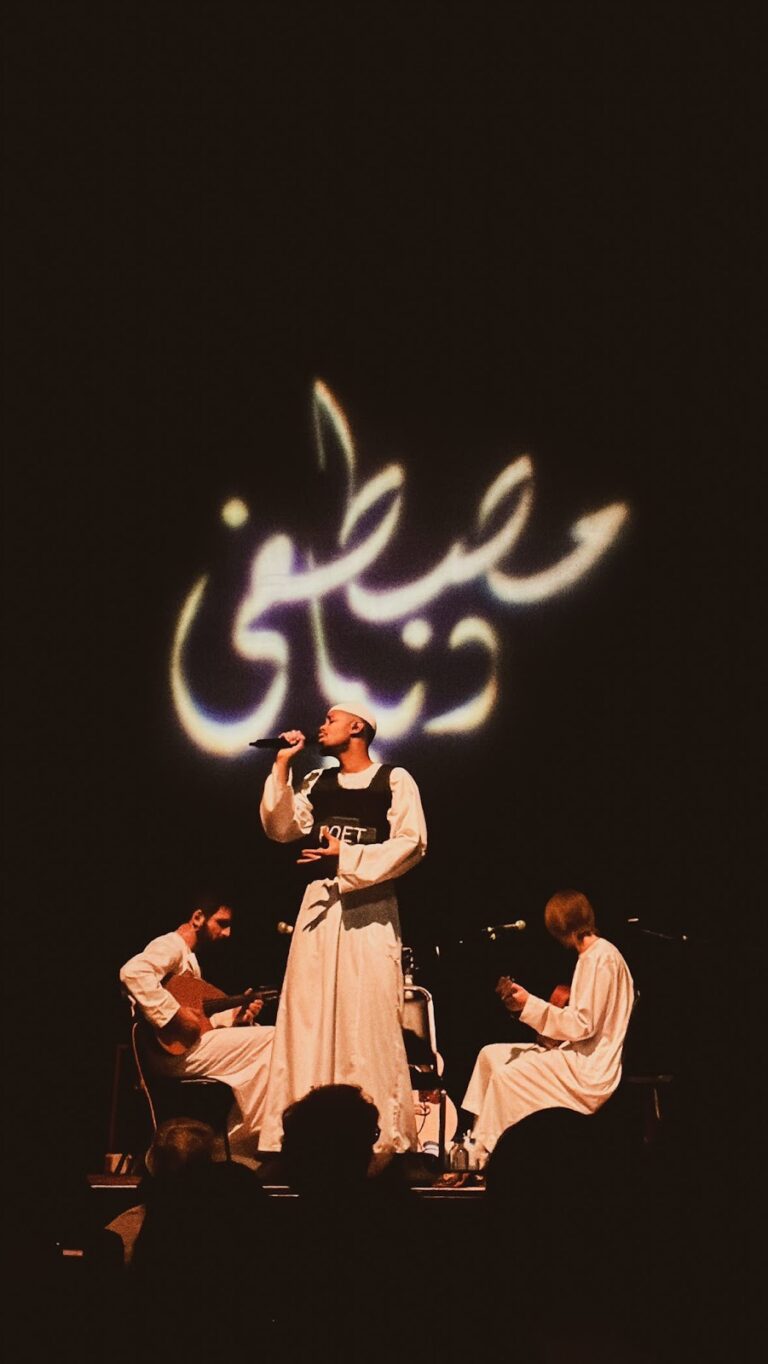
Beneath the intricate chandeliers of Lincoln Theater in DC’s famous U Street corridor, Mustafa’s simply decorated stage featured only spare guitars and ouds. Greeted by a black screen with white text that read Dunya in Arabic script, the audience gradually streamed into their seats as it drew closer to eight. Many attendees draped their keffiyehs over their shoulders or sported clothing in support of the people of Gaza and Sudan, for whom the Canadian-Sudanese artist has consistently advocated for amidst the ongoing genocides. Groups of fans chatted around me, eagerly awaiting his first set of appearances since the Artists for Aid concert last summer and Mustafa’s first world tour. As the lights dimmed, Mustafa entered the stage from the left, dressed in a white caftan under his signature black “Poet” press vest. Mustafa humbly took a seat facing the audience with his two instrumentalists behind him.
He began the evening in prayer, addressing the crowd in a blend of Arabic and English before easing into “Nouri.” The somber, repetitive questions of the chorus, supported by the gentle strumming of the oud, dictated the tone of the night, which Mustafa compared to a funeral. As explained by the artist, he originally intended the album to be about death, as a tribute to the friends he lost. But to do so, he said, “I had to write about the world in its entirety. Then, I had wanted to write about faith, but I realized I had to write about the world in its entirety.” Thus emerged Dunya, which in Arabic translates to the material world, or the world in all its flaws. Between songs, Mustafa returned to his chair, sharing the stories behind each, which prompted one older couple behind me to comment on the incredible wisdom of the young artist.
Yet for a performance centered around eulogies—for the dead, the living, and especially the mourning left with memories of both— the show is better characterized as a celebration of life. In lengthy anecdotes, Mustafa shared the moments of joy that eased the difficulties of growing up in a rough neighborhood of Toronto, dealing with loss and personal struggles with faith. Finding these moments of joy, whether creating them for others—like his story of telling a white lie (that he was a doctor) to his New York cab driver who reminded him of his East African father to make him proud—or making the most of unfortunate circumstances—like his friends being unable to contain their laughter as a friend recited their last prayers, despite only being shot in the foot—remains a central aspect of his music. In his words, “the beauty of the music is photographing the feeling, leaving a capsule for them to return to it.” Although much of Mustafa‘s music is inspired by grief, his performance served as a collective reminder of the power of joyful resilience in the face of oppressive systems.
Mustafa’s unique blend of folk features electronic switch-ups like the energetic end of “Gaza is Calling” and a looped background rap verse in “Leaving Toronto.” Combining guitar rhythms and raw vocals that could fit around a campfire with melodies inspired by his Sudanese heritage (including the occasional Hadandawa neck dance) and the urban influences of his youth, the creative production enhances Mustafa’s lyrical prowess. This juxtaposition melds with the internal contradictions and questioning nature of the album, capturing the emotional complexity of living in this Dunya.
In “SNL” Mustafa tackles the struggles of growing up in the Regent Park neighborhood of Toronto, in one of Toronto’s oldest housing projects. “It’s the thesis of everything I’ve written—about growing up in the hood, [and trying] to make light of the world around us.” Mustafa’s deeply personal reflections revealed a striking vulnerability that made the concert an intimate experience. Here, he expressed his doubts about going on tour, because the heavy themes in his music seemed inappropriate, and his own lack of confidence.
Midway through, Mustafa cut his unanticipated acapella rendition of “Ali”, dabbing his eyes with his own durag as his voice failed him. He apologized profusely to the sympathetic crowd, who clapped and shouted their unconditional support. After regaining his composure, Mustafa expressed the difficulty of performing a song dedicated to someone who could no longer hear it, before launching into one of the more uptempo tracks on the album, the fan favorite, “Name of God”.
As Mustafa’s voice faded at the song’s close, the backing track returned to fill the void, playing an audio conversation between Mustafa and his cousin Mahmoud. “A human and a Muslim,” he echoes in the last line, a guiding principle of not only the album but the artist himself. From the early performance of “Imaan,” which literally translates to faith, to a spirited reaffirmation of finding his own connection to God in the final song of the night, “I’ll Go Anywhere,” Mustafa underscored faith’s reassuring presence through challenges such as reconciling the loss of his brother (“What Happened, Mohamed?”) and remembering former partners (“Old Life”).
Yet, as evidenced by the audience’s warm reception, Mustafa is much more than his own humble musings. As the show came to a close, he quoted Toni Morrison, emphasizing the importance of building community while paying respect to the Muslim and East African immigrant communities that were so crucial to his personal development. Emerging from Lincoln Theatre that night, I truly felt a part of a community, bonded through mutual mourning, inside jokes, and personal stories. For all those feeling lost in the dunya, Mustafa reminds us that even if this life is fleeting, full of grief and haunted by our pasts, every moment is worth living.