
By Zach Gindi-Chiafullo
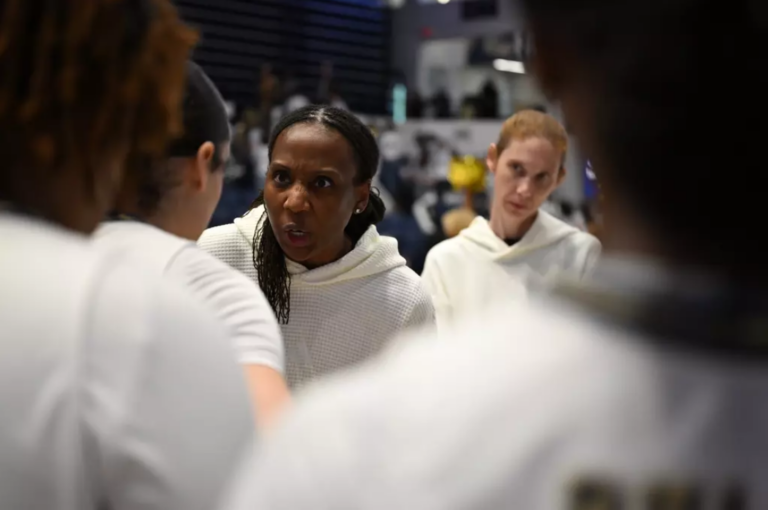
Stepping in as the new head coach of the GW women’s basketball team for the 2025-26 season, Ganiyat Adeduntan inherited a rebuilding program and immediately injected it with a sense of urgency and care. Now, with a successful season in the books–marked by a Great 8 appearance in the Women’s National Invitation Tournament–she has proven that her focus rarely leaves her young, talented, and athletic players, who brought grit and fight for the team this past season.
After all, she’s been in their shoes before.
From 2002 to 2006, Adeduntan was a standout guard for the Florida State Seminoles, where she scored over 1,000 points and earned All-Freshman honors in 2003.
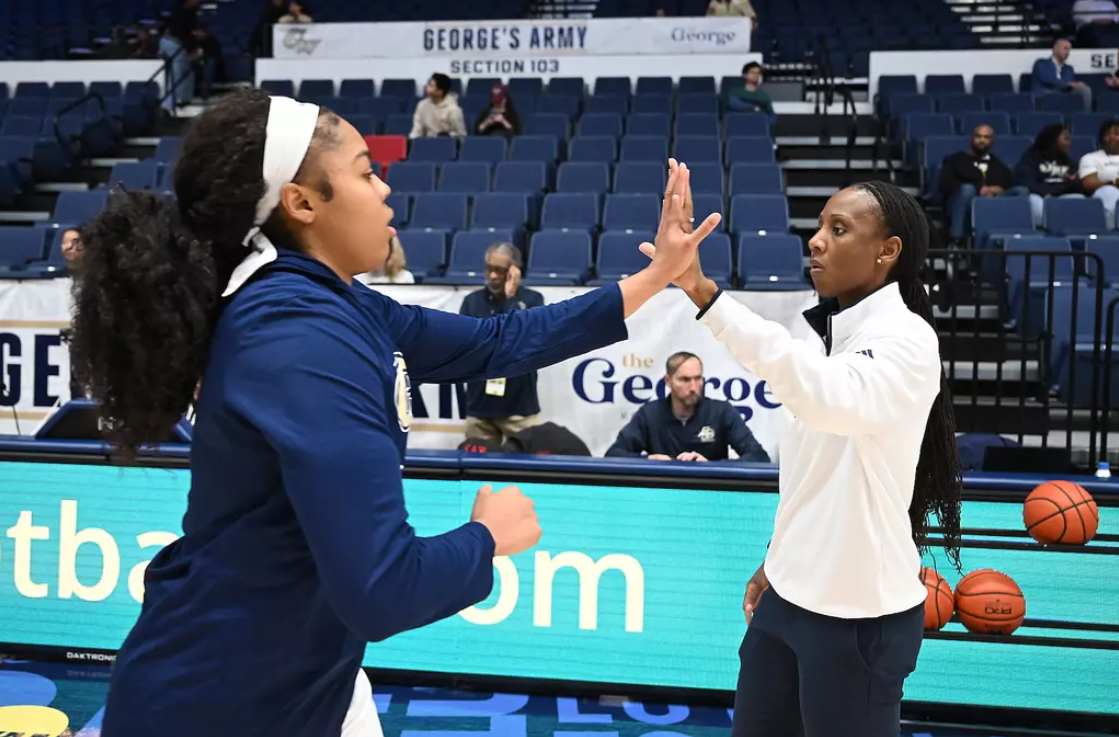
Adeduntan ahead of her first game as head coach (photo by Greg Fiume/GW Athletics)
After working as a nurse practitioner and coaching in Division III, she served as an assistant at Northeastern University and then as the assistant coach at GW from 2017 to 2021. This was followed by a successful stint as the head coach of Colgate University from 2021 to 2025, where she posted a 65-61 total record and led the team to consecutive 20-win seasons in her final two years there. Adeduntan returned to Foggy Bottom to take over as the head coach of the Revolutionaries.
“I chose a place that I have familiarity with so that it didn’t take too long to get adjusted,” she said, reflecting on the decision of returning to the nation’s capital.
Adeduntan’s mission for the Revolutionaries in her inaugural season was not just to win, but to build a new standard on a foundation of competition, effort and identity.
“I wanted to have a team that always had a chance when we stepped on the floor,” Adeduntan said. “We spent a lot of time trying to form a unit that really leaned on what we felt was important for what we wanted the product to be.”
The season began on a high note with a blowout home win over the University of the District of Columbia; however, uneasiness settled in as the Revolutionaries then endured a four-game losing streak.
Adeduntan reflected that early on, the team “did not play hard enough early on,” and that they “did not buy into the defensive end” in the way they needed to amid the skid, and was inconsistent in their production on the court.
But in her eyes, she viewed the team’s overtime loss to the Miami Hurricanes at the Cayman Islands Classic in late November as the moment they played their hardest–and the turning point that began to define their season, marking the introduction of the ‘Coach G’ era at GW.
After this loss, a seven-game winning streak sparked. Aggressiveness persisted. Effort rebounded. Explosiveness and high-energy plays were infectious on offense and defense.
They garnered 18 total season wins–five more than the previous year–solidifying Adeduntan’s career with the Revolutionaries. Thirteen of these wins were at home, the most since 2014-15.
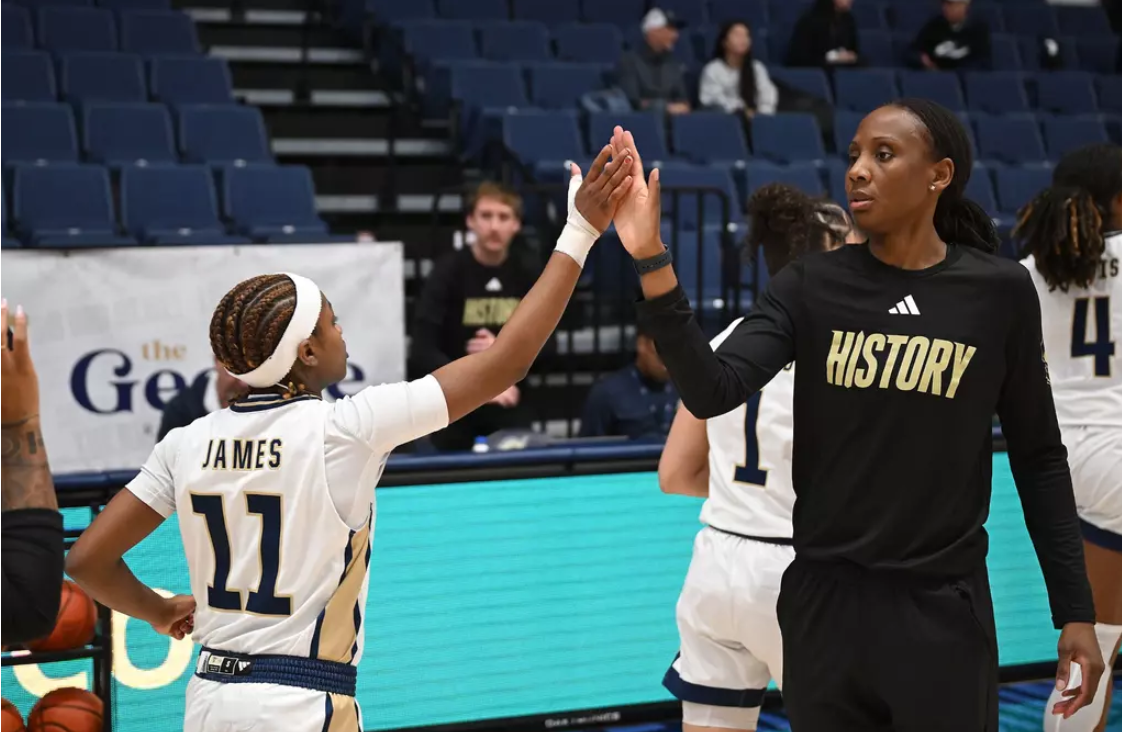
Adeduntan and Mia James ahead of 57-54 overtime win over the Richmond Spiders (photo by Greg Fiume/GW Athletics)
After each game, Adeduntan mentioned that the team collectively reviews the positives, the negatives, and plans future tactics. Once they got into a rhythm of effective court movement and maintained competitiveness through maximum effort during the season, they were “able to take big strides forward,” Adeduntan explained.
The home wins provided fans with a new perspective on GW women’s basketball under Adeduntan, to the delight of many. This was especially true for the GW Foghorns, the university’s pep band, who were present at every home game and postseason tournament to energize the crowd and players. University students in the band were thrilled, from freshmen experiencing an exciting new era to seniors enjoying a high-energy conclusion to their careers.
“I feel like I’m watching something grow,” said freshman Jacob Banta, a trombonist for the Foghorns. “There definitely isn’t a big sports culture at GW, but it seems that athletics has really been trying to get something started as of recently.”
Despite a successful season, Banta noticed a dull atmosphere at home games. He said community members and alumni often cared more than the average student, and even high-stakes matchups failed to fill the Charles E. Smith Center. He added that “it’s hard to tell how much people actually pay attention to the band,” noting their game-day energy often goes unnoticed during games.
Still, this season gave him hope for the future.
“The team’s success definitely changed how I experienced the games. When we were on a hot streak, every game felt so fast and exciting,” Banta said, describing the pride as being part of a community that gets to rally behind their student athletes.
Banta’s first year in the Foghorns has allowed him to understand the intimate atmosphere of the Smith Center and the grit the team displays at every home game. “As a freshman, I haven’t really experienced different coaching schemes, but I can tell Coach Adeduntan is doing her best–and from what I’ve heard, this is the best the team has performed in a while,” he said. Banta looks forward to what lies ahead for women’s basketball at GW.
Similarly, Michael Brown, another Foghorns trombonist, remarked: “This season felt different, like a rollercoaster, evidenced by our postseason run.”
However, like Banta, the senior noted limited support for the team at home games throughout this season, aside from “a few dedicated fans” he repeatedly recognized in the stands.
In previous years, Brown felt GW’s women’s basketball program had a high floor but a low ceiling, though he noticed a distinct shift under Adeduntan compared to former head coach Caroline McCombs.
“Coach Adeduntan clearly has respect for her players,” he said. “This team didn’t have much history together, but they carried themselves with pride as a cohesive unit.”
For Brown, contests such as the aforementioned overtime loss to Miami at the Cayman Islands Classic–which fueled the team’s December winning streak–and the mid-February overtime victory over the Richmond Spiders stood out as turning points of the season. “It showed that they could beat anyone”, he said, a belief the team ultimately backed up with multiple wins in the WNIT.
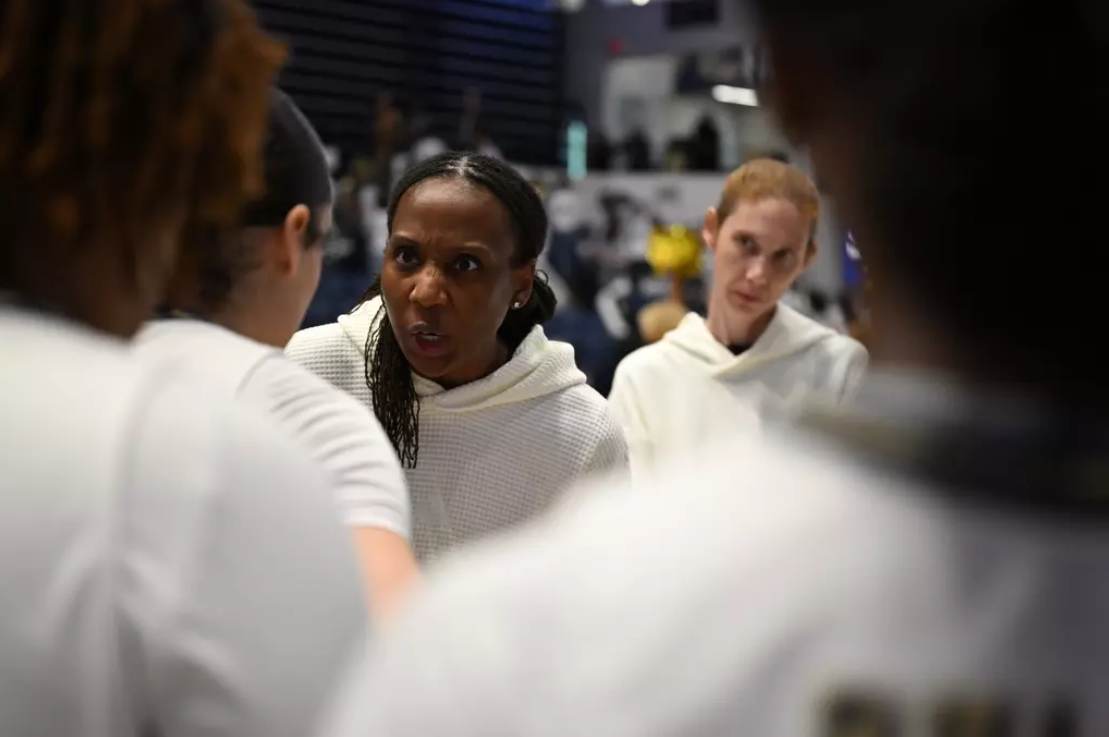
Adeduntan in WNIT win over Loyola Chicago (Photo by Dylan Davies/GW Athletics)
“The future looks bright, I’d say,” Brown added, reflecting on his final year as part of the pep band. “I’ll always cherish my time as a Foghorn, and likely stay a strong fan of GW women’s basketball because of it.”
Adeduntan’s coaching approach is unique, emphasizing a “player’s coach” philosophy and prioritizing strong relationships with each member of her team, while sharing in the joy of their effort, growth, and competitiveness.
“Being able to work with young people and helping them grow and develop into even better citizens for this world is very important to me, so that when they leave college, they can have these tools and skill sets to help them accomplish or maneuver in any kind of way they need to in life,” Adeduntan said.
Her dedication was perfectly captured during a single, chaotic interview, where she balanced a player’s medical update with her duties as head coach. “Sorry, one of my players is at the doctor’s office,” Adeduntan said, pausing before adding, “I’ve got a lot going on right now,” yet still insisted on continuing.
That focus on her players’ holistic growth, both on and off the court, underscores her philosophy: “Being able to work with young people and helping them grow and develop into even better citizens for this world is very important to me, so that when they leave college, they can have these tools and skill sets to help them accomplish or maneuver in any kind of way they need to in life,” Adeduntan said.
This season was only the beginning of something new emerging at GW, and it is already unfolding in real time.